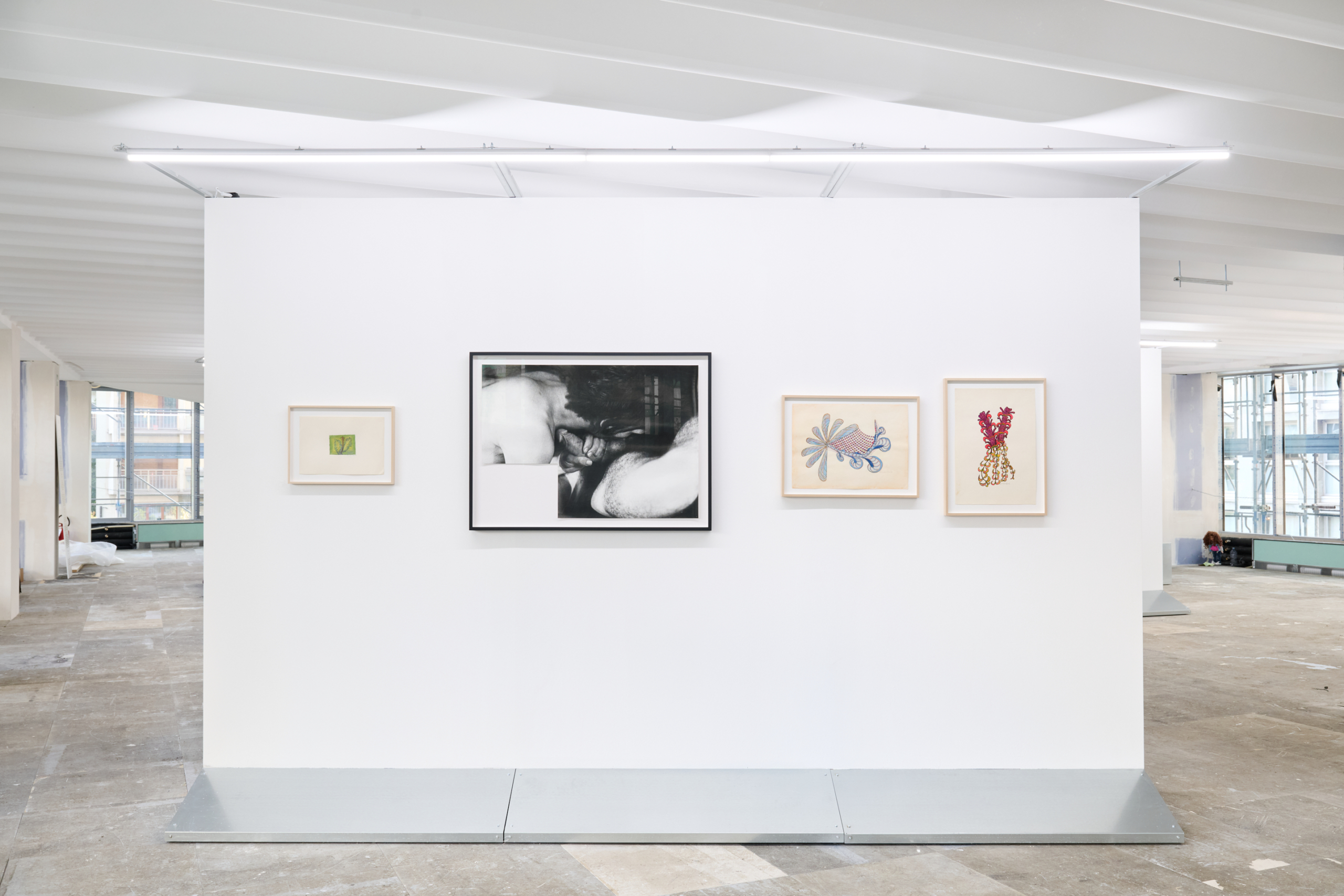
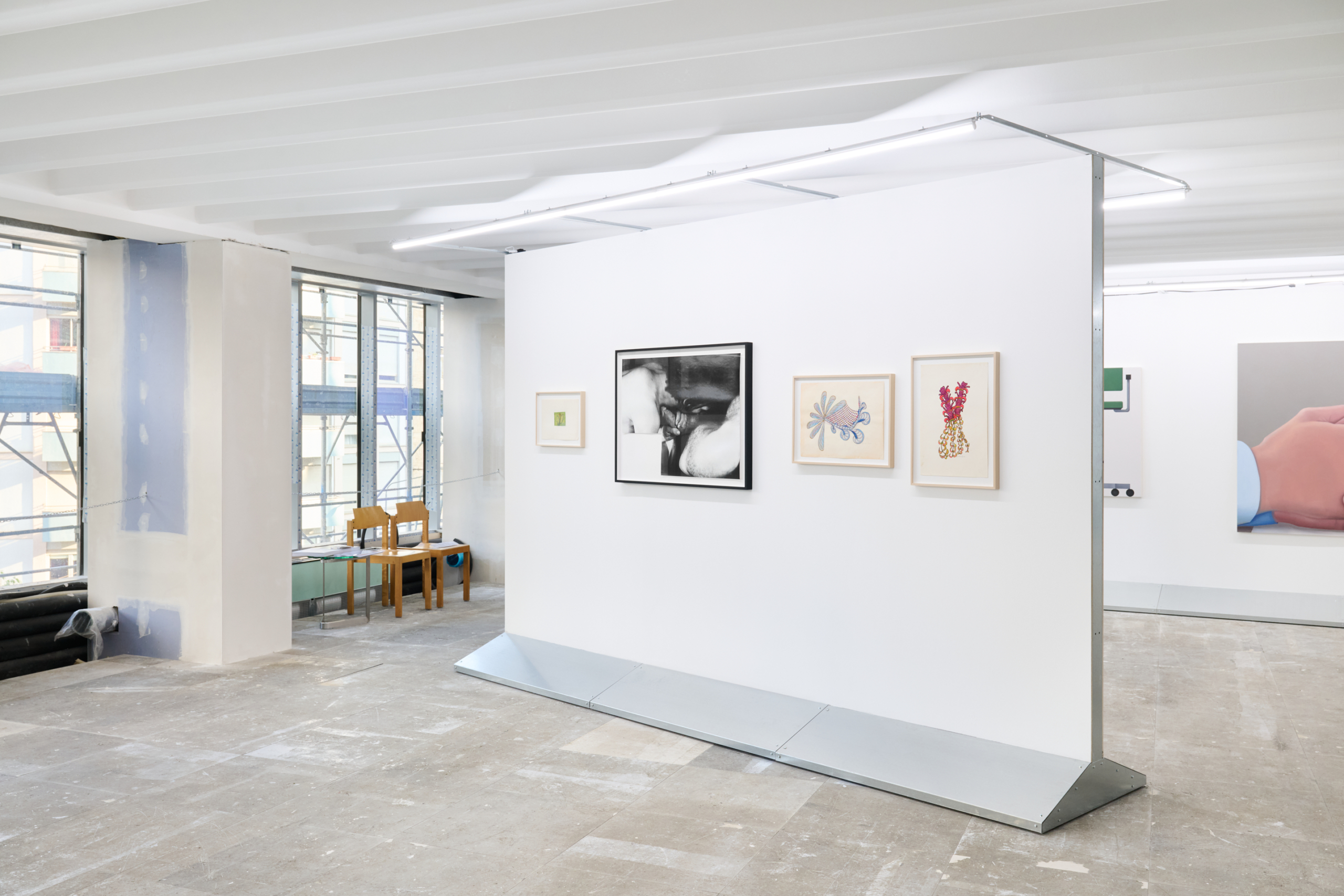
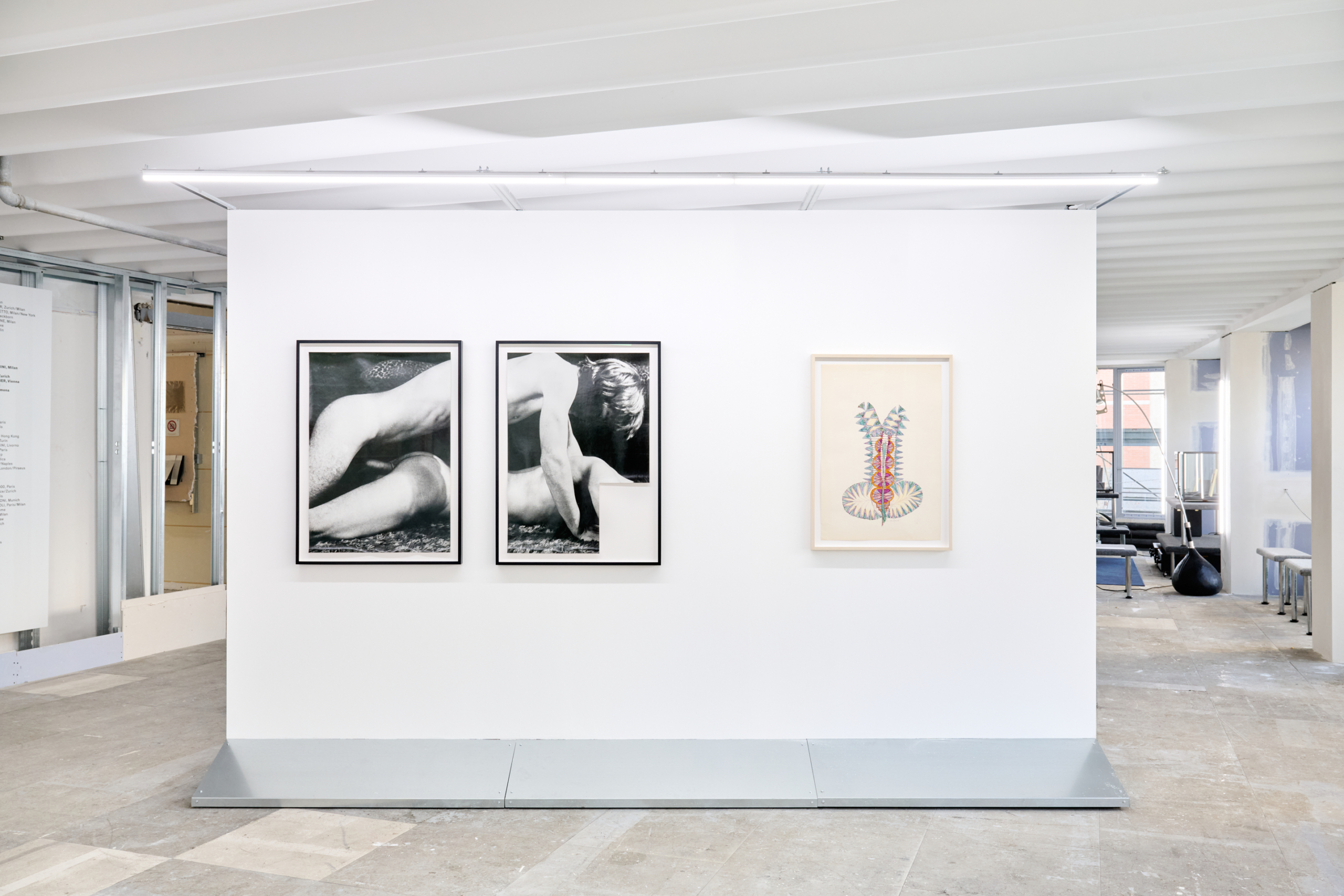
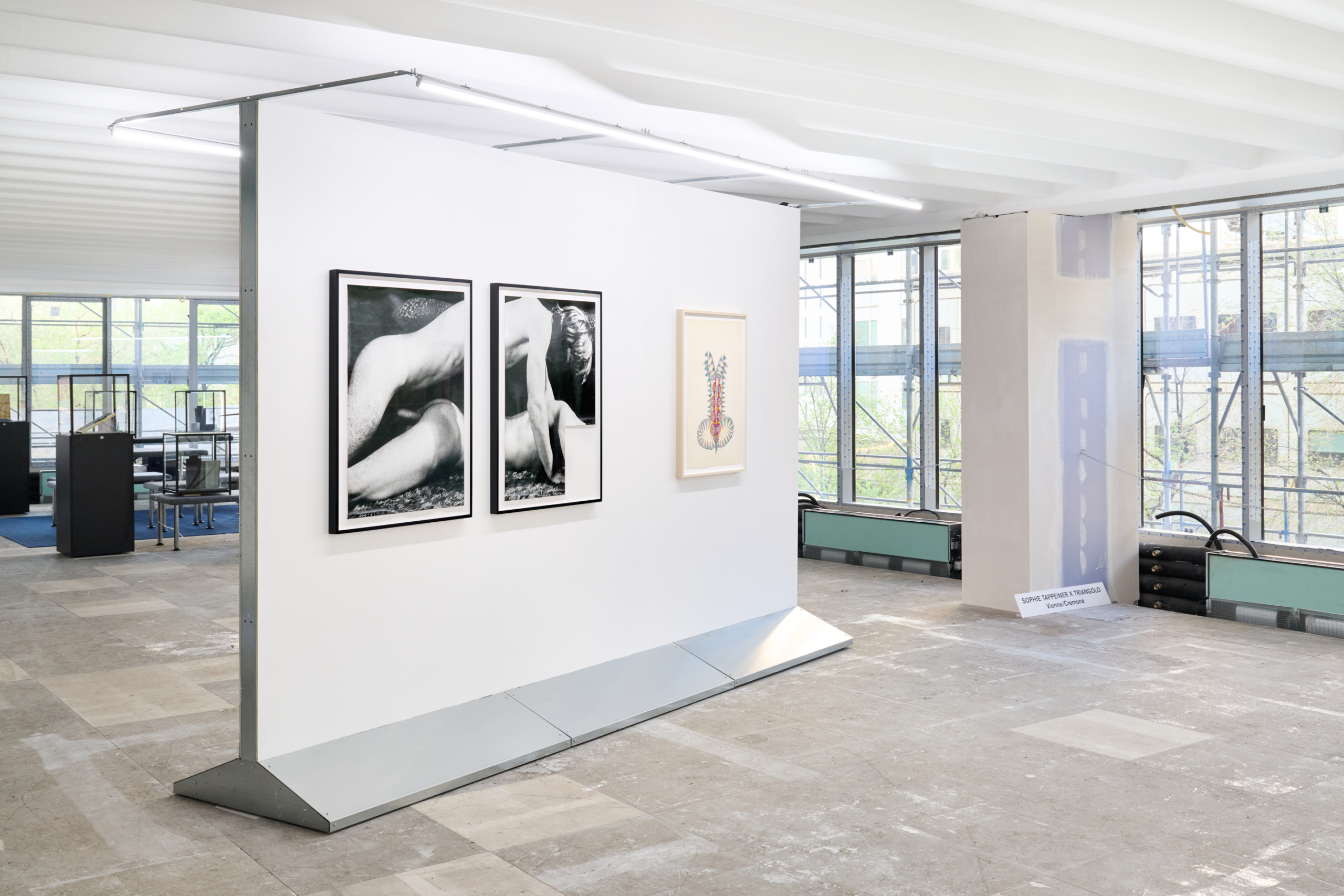
In a shared presentation by SOPHIE TAPPEINER (Vienna) and Triangolo (Cremona), the works of Samuel Haitz and Anna Zemánková are brought into proximity, creating a space where these distinct practices engage in dialogue. Haitz’s black-and-white photographic language meets Zemánková’s vivid, chromatic surfaces, allowing differences in medium, tone, and temporality to resonate.
Haitz’s works derive from rephotographed pages of an anonymous gay magazine, likely from the 1970s. Devoid of authorship or stable historical markers, the images exist in a suspended temporal register, both archival and immediate. The analogue process lends them pronounced physicality, with grain, tonal depth, and the subtle movement of the baryta surface asserting the photograph as both image and object. Cropping and cutting remove details that might anchor the images in a specific past, emphasizing formal and affective qualities. By enlarging and reworking the source material, reproduction becomes a transformative act, allowing the image to shift across material and perceptual states.
Zemánková’s works, created mainly in the 1960s and 70s, emerge from an intuitive and highly personal process often aligned with “pure psychic automatism.” While frequently considered alongside Hilma af Klint and Emma Kunz, her practice remains rooted in a sustained exploration of form as a living system. Compositions unfold through intricate arrangements of line, color, and texture, forming biomorphic structures that suggest ongoing growth and internal rhythm. Across media, her surfaces—sometimes subtly embossed or materially built up—carry a tactile, almost sculptural presence.
Alongside Haitz’s photographs, Zemánková’s forms shift in register. Across pastel, collage, and sateen, elements unfold, mirror, and merge, resisting fixed classification. What might otherwise be read as botanical or abstract becomes more ambiguous, hovering between organic growth and corporeal suggestion. This oscillation highlights a shared interest in transformation and permeability, where boundaries between interior and exterior, image and body remain in flux. Zemánková’s intricately worked surfaces enter into quiet dialogue with Haitz’s photographs, where the analogue process affirms the image as a physical, responsive object.
Despite differing origins—Haitz working with found imagery, Zemánková with a self-generated visual language rooted in the subconscious—both practices converge in their attention to process, materiality, and the instability of form. In this shared space, images are not fixed but continuously becoming, shaped as much by their making as by their reception.
PRESS